
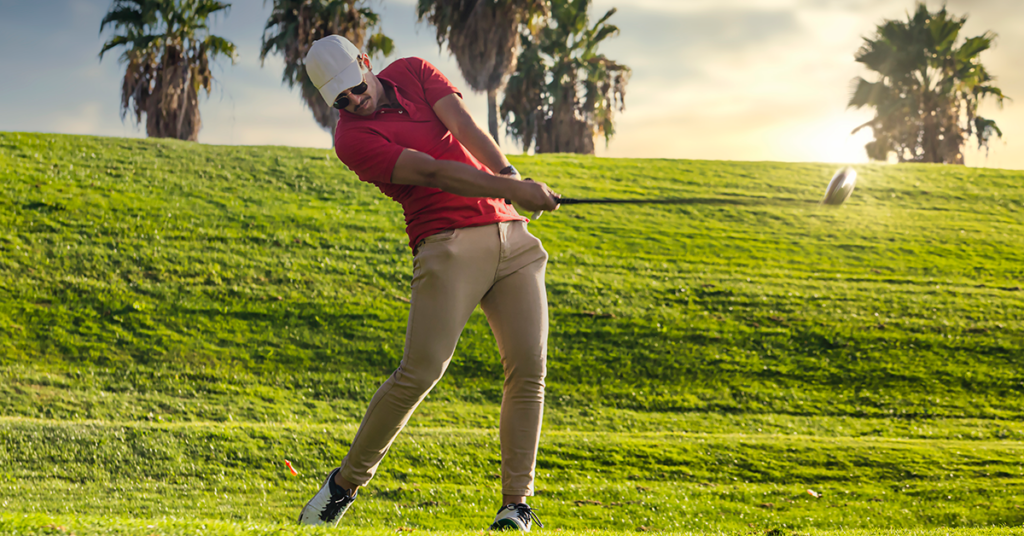
The hips play a major role in how power moves through the golf swing. This article explores rotation, sequencing, balance, and why sliding disrupts efficient movement.
Why the Hips Matter
If your swing feels weak, out of sync, or inconsistent, the issue can often come back to one place.
How your hips are moving.
The hips sit at the center of the swing, connecting the lower body to the upper body and playing a major role in how energy moves through you.
You can have solid footing and stable knees, but if the hips aren’t moving well, energy doesn’t transfer efficiently and the swing starts to break down.
From Support to Power
In the last piece, we talked about the legs and how they provide support, manage pressure, and carry energy upward, but they don’t decide where that energy goes… the hips do!
As pressure builds into the ground and moves through the legs, the hips begin to rotate and shift in a way that directs that energy through the body. This isn’t a forced action, it’s a response to how the body is loading and moving. The direction, timing, and quality of that movement determine whether energy flows efficiently upward or gets lost along the way.
This is where support becomes power, not because the hips are trying to generate it, but because they allow it to move through the body in a coordinated and connected way.
When the hips move well, the swing feels connected. When they don’t, everything starts to feel forced.
Rotation vs. Slide
This is where the swing really starts to separate.
The hips are designed to rotate, creating a motion that keeps the body centered while allowing energy to move upward and through the swing. When that rotation is working well, everything begins to sync, movement feels connected, balanced, and repeatable.
But when the hips start to slide instead, the entire motion begins to break down.
Rather than turning, the body drifts. The center shifts, balance starts to slip, and the flow of energy is disrupted before it ever has a chance to build. What should feel smooth and connected starts to feel rushed and out of position.
That difference between rotation versus slide is one of the defining lines in the golf swing. It’s the difference between a motion that works with the body and one that constantly fights to recover.
And once recovery becomes part of the swing, consistency becomes very difficult to find.
What Sliding Really Does
Sliding isn’t a small issue, it changes the entire structure of the swing.
When the hips move laterally instead of rotating, pressure shifts too far to the outside of the trail foot and the body begins to move off center. From there, rotation becomes limited, the sequence starts to fall behind, and the downswing turns into a recovery instead of a release.
Now the swing has to catch up.
The arms and hands step in to compensate, trying to square the club and create speed late in the motion. Timing becomes more important than structure, and consistency starts to fade.
And this is where power begins to leak.
Energy that was built from the ground up never fully transfers through the body. Instead of moving cleanly through the hips and into the upper body, it gets redirected, delayed, or lost altogether. What could have been a smooth release turns into a rushed effort to create speed at the last moment, so a lack of speed isn’t a lack of effort, it’s the result of movement working against itself.
What Good Hip Movement Feels Like
Most golfers hear “rotate your hips” and immediately try to force it.
That usually creates more tension than movement.
There’s a reason for that.
The hips don’t work in isolation. They’re closely tied to the legs, and when you try to rotate them by themselves, you quickly run into a limit. The joint is built for stability, and without the rest of the body moving with it, rotation feels restricted and disconnected.
At the same time, your upper body is built very differently. You can turn your chest while your lower body stays relatively stable because your upper spine is designed for rotation. That’s why it feels so much easier to move your chest than your hips on their own.
That’s not how the swing works.
In the golf swing, the hips respond to what the body is doing, pressure shifting through the feet, balance staying centered, and the body turning as a connected system. When those pieces are working together, the hips don’t need to be forced to rotate because they begin to move naturally as part of the motion.
This is where awareness comes into play.
Pay attention to how pressure moves through your feet, whether your balance stays centered, and whether your body is turning or drifting. Those things directly influence how the hips move during the swing. When pressure and balance stay organized, rotation becomes much easier and more natural, something that happens as a result of efficient movement, not something you have to force.
When the body is working together, the movement feels more connected, more balanced, and far easier to repeat.
How This Connects to Your Practice
Power doesn’t start with swinging harder.
It starts with learning how movement works through the body.
The ground provides the energy.
The legs support and carry it upward.
The hips help direct and transfer it through the swing.
When one part falls out of sequence, the body begins compensating and power starts to leak away.
That’s why practice matters.
Instead of trying to force positions, work on the parts of movement that allow the swing to stay organized. Work on staying centered during rotation. Work on how pressure moves through your feet. Work on turning without drifting or sliding out of balance.
Over time, those movements begin to work together more naturally.
And the more clearly your body experiences efficient movement, the easier it becomes to repeat.
Use your awareness to train your feel.
Where ParFection Fits In
One of the hardest parts of improving the golf swing is knowing what your body is actually doing.
Most golfers rely on feel alone—but feel can be misleading.
That’s where ParFection changes the learning process.
ParFection is a visual training aid designed to help golfers become more aware of posture, balance, and body movement during the swing. Using instant visual feedback, it allows you to see when your body stays organized and when it begins to drift, slide, or lose balance.
This becomes especially valuable when working on hip movement.
When the hips rotate efficiently, the visual border remains the same. But when the body begins sliding laterally or moving off center, the border shifts and the movement becomes immediately visible.
Instead of guessing, you receive clear feedback in real time.
That feedback helps train awareness, improve movement patterns, and build a more connected swing from the ground up. ParFection helps you recognize what efficient movement actually feels like.
And once you can recognize it, you can begin repeating it with far more consistency.
Closing Thought
The hips don’t create power on their own, but they play a major role in how power moves through the swing. They take the energy built from the ground and help transfer it through the body in a coordinated and efficient way.
When the hips are working well, the swing starts to feel connected, balanced, and repeatable. But when they begin sliding instead of rotating, the body falls out of sequence and starts fighting to recover.
That’s why powerful swings rarely look forced.
The body is working together, energy is moving efficiently, and movement is building naturally from the ground up.
And right in the middle of that process are the hips.
Part of The Swing System
This article is part of a series focused on how the body moves in the golf swing. Each piece builds toward a more organized and repeatable motion.
Continue the Swing System:
The Legs: Where Support Becomes Power