
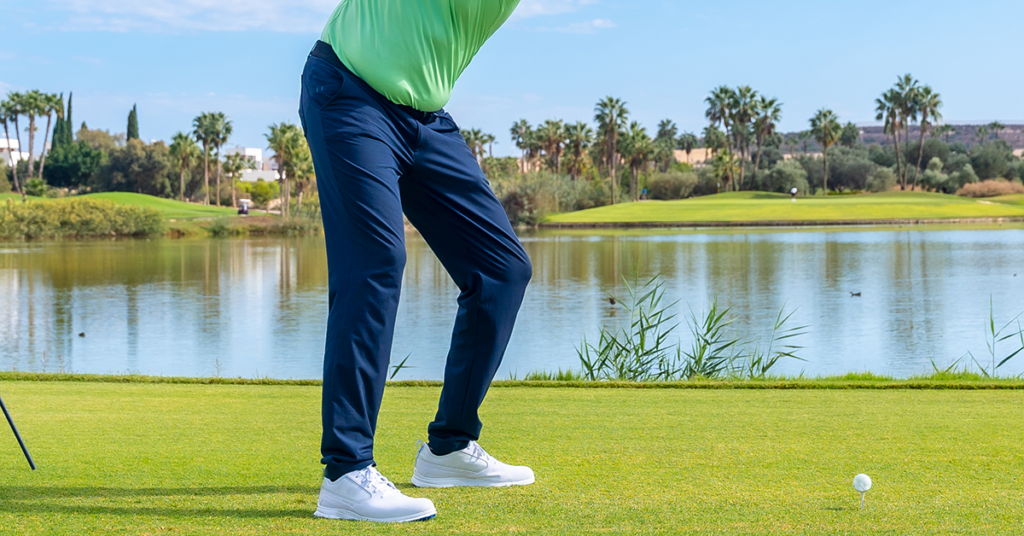
Power in the golf swing is often associated with speed — how fast the club moves or how hard the ball is struck.
But power doesn’t begin with the club.
It begins with how the body interacts with the ground.
Before the arms move, before the club accelerates, the body is already working through the ground to create force. The legs play a central role in that process, supporting the body while carrying energy upward through the swing.
Understanding how the legs function in this way can change how the swing feels — and how it performs.
The Body Needs the Ground
Powerful movement in almost every sport begins with the ground. The body pushes against the ground, and the ground pushes back. That interaction creates force.
A simple example makes this clear. Imagine trying to jump while sitting in a chair. You can swing your arms as hard as you want, maybe push your chest out, but without your feet pressing into the ground, very little happens. The body needs that connection with the ground to create meaningful power.
The golf swing works in a similar way. The ground provides the energy, and the body organizes that energy into motion.
In the swing, the legs play a central role in that process.
The Legs: The Bridge Between the Ground and the Swing
The feet connect the body to the ground, but the legs are what carry that force upward through the body. They form the link between the ground and the motion of the swing, allowing energy to move from a stable surface into a dynamic movement.
The legs may not hold the club, but they play just as important a role in swinging it.
As the body interacts with the ground, force is created through pressure. The legs receive that force and guide it upward, supporting the body while allowing it to rotate. This is where support and motion begin to work together.
When this process is working well, the swing starts to feel connected rather than segmented. Instead of different parts moving independently, the body begins to move as a coordinated system — with energy building from the ground and flowing through each part of the swing in sequence.
Support Comes Before Power
Before the body can create power, it must first be supported.
At address, the body is organized around balance. As the swing begins, that balance doesn’t disappear — it has to be maintained while everything starts to move.
The legs play a central role in that. They support the body as it shifts, rotates, and responds to the ground. The movement isn’t forced. It’s allowed, because there’s something underneath it holding everything together.
When that support is there, the swing tends to feel more stable without feeling restricted. The body can move, but it doesn’t feel like it’s searching for balance along the way.
And from that stability, power has somewhere to build.
Where Power Actually Builds
Some of the strongest muscles involved in the golf swing sit in the upper legs and hips. The thighs and glutes help support the body while allowing it to rotate, creating a balance between stability and motion.
As the body interacts with the ground, the legs begin to do more than just support. They start to contribute to the movement itself. Pressure into the ground creates force, and the legs help carry that force upward while the body turns.
Teaching Moment: The Role of the Glutes
The glutes play an important role in maintaining posture during the swing. As the body rotates, they help stabilize the hips and support the spine angle established at address.
When that support is present, the body can rotate without losing its structure. The motion feels more centered, and the body doesn’t need to make last-second adjustments to stay balanced.
The goal isn’t to tighten or force anything. It’s to allow the body to stay supported while it moves — so rotation can happen without breaking down the position you started from.
How Force Moves Through the Body
In an efficient swing, power doesn’t appear all at once. It builds through the body, starting from the ground and moving upward.
As the feet press into the ground, force is created. The legs receive that force and begin to carry it upward while the body rotates. From there, the motion continues through the hips, into the torso, and eventually into the arms and the club.
Each part of the body adds to the movement, but the sequence matters. When the motion begins from the ground and moves upward, the swing tends to feel more connected — as if each piece is working with the others rather than trying to catch up.
Teaching Moment: Why Ground Force Matters
Studies using force plates show that skilled golfers use the ground more effectively to create motion. They apply pressure into the ground in a way that allows force to build and move through the body.
When that interaction with the ground is limited, the body still tries to create speed, but it often has less to work with. Movement can start to feel more effort-driven rather than supported.
When the legs organize and transfer that force well, the swing often feels smoother, more balanced, and easier to repeat.
What the Legs Should Feel Like
As the swing begins, the legs aren’t something you need to control directly. They respond to how your body interacts with the ground.
You may notice a steady sense of pressure through the feet. Not fixed in one spot, but shifting in a way that keeps you balanced as the body moves.
The knees feel responsive — not locked, not overly active — just available to move as the swing develops.
Through the upper legs, there’s a sense of support. The body feels held in place without feeling restricted, allowing rotation to happen without losing posture.
And underneath it all, there’s a subtle awareness that the ground is supporting the motion. Not something you force, but something you begin to recognize.
These sensations are small, but they matter. They give the body a reference point — something it can return to and build from.
How This Connects to Your Practice
You don’t need to think about force plates or biomechanics while you practice.
But understanding that power begins with the ground and moves through the body can change what you pay attention to.
Instead of focusing only on the club or the arms, notice how your body interacts with the ground.
Feel the pressure in your feet.
Notice how your legs support your posture.
Pay attention to how movement begins from the ground up.
This is where awareness starts to turn into feel.
Closing Thought
The golf swing does not create power in one place.
It builds power through the body.
The ground provides the energy.
The legs carry that energy upward.
The rest of the body turns it into speed.
And that process begins long before the club ever reaches the ball.
Part of The Swing System
This article is part of a series focused on how the body moves in the golf swing. Each piece builds toward a more organized and repeatable motion.
Continue the Swing System:
The Knees in the Golf Swing — The Overlooked Join